Turkish Mosaic Lamp vs Tiffany vs Stained Glass
They all glow with coloured glass, but they are made differently and light a room differently. Here is a clear comparison.
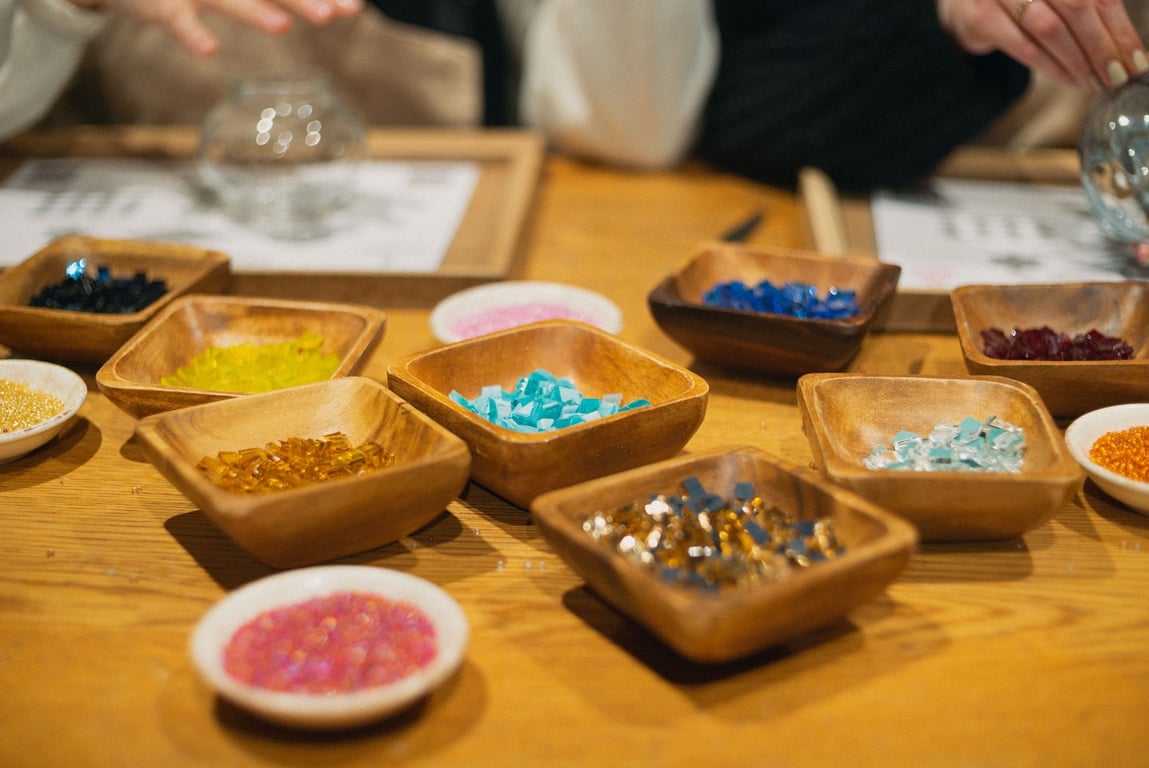
A Turkish mosaic lamp, a Tiffany lamp, and a stained-glass panel all turn coloured glass into light. Yet they are made by different methods, and each gives a room a different kind of glow. Maybe you are deciding what to make or buy. Or maybe you just want to tell them apart. Either way, here is the honest comparison.
Turkish mosaic lamp
Small pieces of coloured glass and beads are set by hand onto a clear glass shade, then grouted in place. The pieces sit slightly apart. Because of that, the light reads as many small points of colour that resolve into a single glow. The shapes are usually rounded, like globes and teardrops, and the geometry follows Ottoman patterns. Nothing is soldered. The glass is simply fixed to the glass form beneath it.
The light is warm, dense, and jewel-like, and it throws patterns across nearby walls.
Tiffany lamp
A Tiffany lamp is named after Louis Comfort Tiffany. It is built with the copper-foil method. First, each piece of cut glass is wrapped in adhesive copper foil. Then the pieces are soldered together into a self-supporting shade, often a cone or dome with floral or landscape scenes. There is no clear form underneath. The glass panels are the shade.
The light is softer and more pictorial, with visible metal seam-lines between the larger panes.
Stained glass
Traditional stained glass is the kind you see in church windows. It joins pieces of coloured glass with lead cames, the H-shaped lead strips, into a flat panel. That panel is usually lit by daylight rather than a bulb. It is the oldest of the three techniques, and it is the ancestor of the Tiffany method.
The light is flat and luminous, designed to be seen against the sky.
Quick comparison
- Joined by: mosaic-set on a glass form for the Turkish lamp, soldered copper foil for Tiffany, and lead cames for stained glass.
- Shape: rounded shades for the Turkish lamp, cones and domes for Tiffany, and flat panels for stained glass.
- Light: a patterned jewel glow, a soft pictorial glow, and daylight luminance.
- Origin: an Ottoman craft, American Art Nouveau, and medieval Europe.
Which one do you make in a workshop?
In an Istanbul workshop you make a Turkish mosaic lamp. That means the hand-set, grouted shade on a glass globe. It is also the most beginner-friendly of the three. There is no cutting glass to shape and no hot soldering iron, just placing colour by hand while an artisan guides you. You can read the full method in how the lamps are made, or simply reserve a seat and make one yourself.